
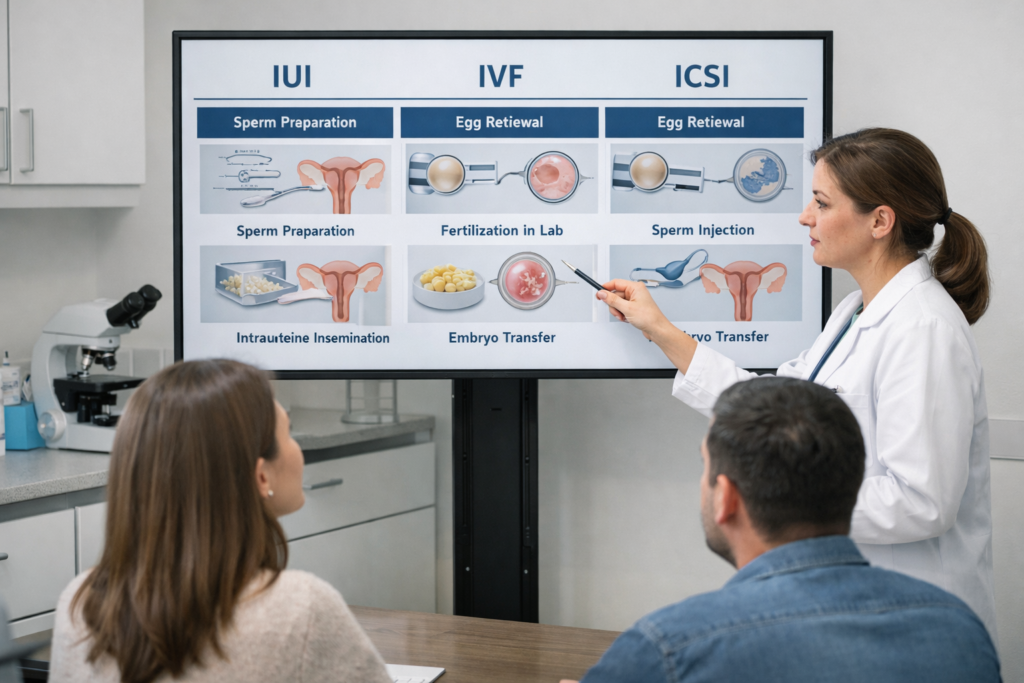
Choosing a fertility treatment can feel confusing, especially when you hear terms like IUI, IVF, and ICSI used interchangeably. Many couples assume that the most advanced or expensive option must be the best—but in fertility care, stronger treatment does not always mean better treatment.
The right choice depends on why pregnancy has not occurred, how long infertility has lasted, age, medical history, and how the body responds to simpler treatments. Some patients conceive successfully with IUI, while others may require IVF or IVF with ICSI due to specific medical indications.
Understanding the differences between IVF, IUI, and ICSI helps patients avoid unnecessary procedures, manage expectations realistically, and move forward with confidence. If you have already reviewed eligibility, testing, or outcomes after previous treatments, this comparison will help clarify which option may be most appropriate for your situation.
This guide explains IVF vs IUI vs ICSI in a clear, ethical, and patient-focused way—based on medical reasoning, not assumptions.
Understanding Fertility Treatments Before Choosing
Fertility treatments are usually recommended in a step-wise manner, starting with the least invasive option that fits the diagnosis. Doctors consider:
- Cause of infertility
- Female age and ovarian reserve
- Male fertility factors
- Duration of infertility
- Past treatment outcomes
Escalating treatment without medical indication can increase cost and emotional stress without improving outcomes. This is why diagnosis matters more than treatment popularity.
What Is IUI and Who Is It Recommended For?
- Mild male-factor infertility
- Unexplained infertility
- Ovulation disorders
- Early fertility treatment stage
Limitations of IUI:
- Lower success rates per cycle
- Less effective with age-related egg issues
- Not suitable for severe male-factor infertility
IUI is often tried before IVF when medical conditions allow.
What Is IVF and When Is It Needed?
In Vitro Fertilisation (IVF) involves fertilising eggs with sperm in a laboratory and transferring the embryo into the uterus.
IVF is commonly recommended for:
- Blocked fallopian tubes
- Severe endometriosis
- Advanced female age
- Failed IUI cycles
- Certain male-factor conditions
IVF allows greater control over fertilisation and embryo selection, but it is not always the first-line option.
What Is ICSI and Why Is It Used?
Intracytoplasmic Sperm Injection (ICSI) is a specialised IVF technique where a single sperm is injected directly into the egg.
ICSI is used when:
- Sperm count or motility is very low
- Previous IVF fertilisation failed
- Sperm DNA issues are suspected
ICSI does not replace IVF—it is performed within IVF when fertilisation assistance is needed.
IVF vs IUI vs ICSI – Key Differences
Comparison Table
| Factor | IUI | IVF | IVF with ICSI |
|---|---|---|---|
| Procedure | Sperm placed in uterus | Egg fertilisation in lab | Direct sperm injection into egg |
| Invasiveness | Low | Moderate | Moderate |
| Ideal candidates | Mild infertility | Tubal / age-related issues | Severe male-factor infertility |
| Success rate (per cycle) | Lower | Moderate–High | Similar to IVF (case-dependent) |
| Cost range | Lower | Higher | Slightly higher than IVF |
| Cycles needed | Multiple | Fewer | Fewer |
*Ranges vary by age, diagnosis, and clinic protocols.
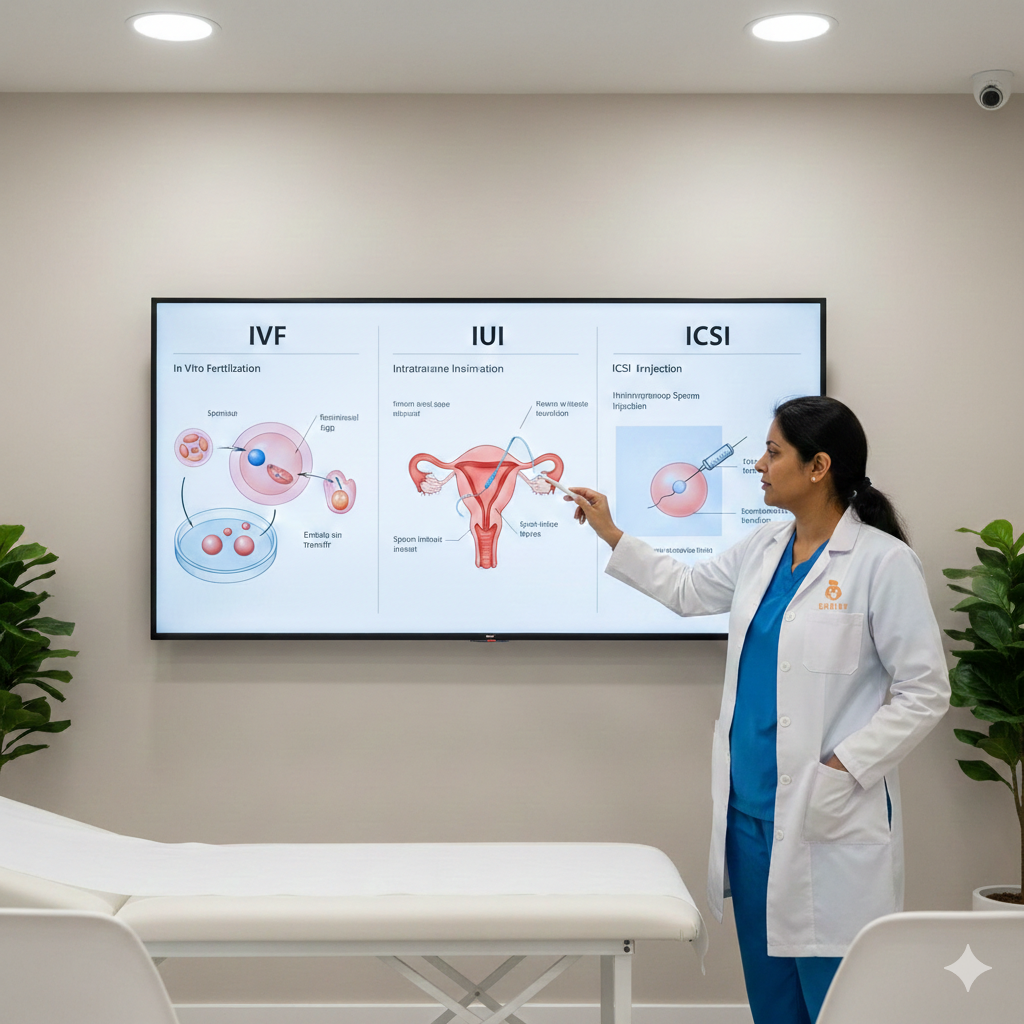
IVF vs IUI vs ICSI – Success Rate Comparison
Success rates depend more on patient profile than treatment name.
- Younger patients may succeed with IUI
- IVF success improves when IUI fails
- ICSI improves fertilisation in male-factor cases
No treatment guarantees pregnancy. Outcomes vary based on age, embryo quality, and uterine factors
IVF vs IUI vs ICSI – Which Treatment Is Right for You?
By Age
- Under 35: IUI or IVF depending on diagnosis
- 35–40: IVF often preferred
- Over 40: IVF with personalised protocols
By Infertility Cause
- Ovulation issues → IUI / IVF
- Tubal blockage → IVF
- Severe male-factor → IVF with ICSI
After Failed Cycles
- Failed IUI → IVF
- Failed IVF fertilisation → IVF with ICSI
Common Myths About IVF, IUI, and ICSI
- IVF is always better ❌
- IUI always works first ❌
- ICSI guarantees success ❌
Medical suitability—not treatment strength—drives success.
Why Fertility Specialists Recommend One Treatment Over Another
Ethical fertility care focuses on:
- Correct diagnosis
- Avoiding unnecessary escalation
- Personalised planning
- Emotional and financial balance
The goal is the right treatment, not the most treatment.
Why Patients Trust SHEIVF for Treatment Guidance
Patients trust SHEIVF because treatment recommendations are based on medical need, not routine escalation. Each case is reviewed individually, with clear explanation of options, limitations, and next steps—allowing patients to decide with confidence and clarity.
Frequently Asked Questions
Which is better, IVF or IUI?
Neither is universally better. The right choice depends on diagnosis and age.
Is ICSI better than IVF?
ICSI helps fertilisation in male-factor cases but does not increase success for everyone.
Can I switch from IUI to IVF?
Yes. Many patients move to IVF after failed IUI cycles.
Does IVF always include ICSI?
No. ICSI is used only when medically indicated.
How many IUI cycles before IVF?
Usually 3–4 cycles, depending on age and response.
Is ICSI only for male infertility?
Primarily yes, but it may be used in selected IVF cases.
If you are unsure which fertility treatment is right for you, consulting a fertility specialist can help clarify options based on your medical profile and treatment history.